

Instrument Configuration
Reference for instrument configuration in Tradeways — tick size, point value, lot size, contract multiplier, and how they drive P&L calculation.
What Is Instrument Configuration?
Every tradeable instrument in Tradeways has a configuration that defines how prices translate into profit and loss. The configuration determines the instrument's asset class, how P&L is calculated, and what currency the P&L is denominated in.
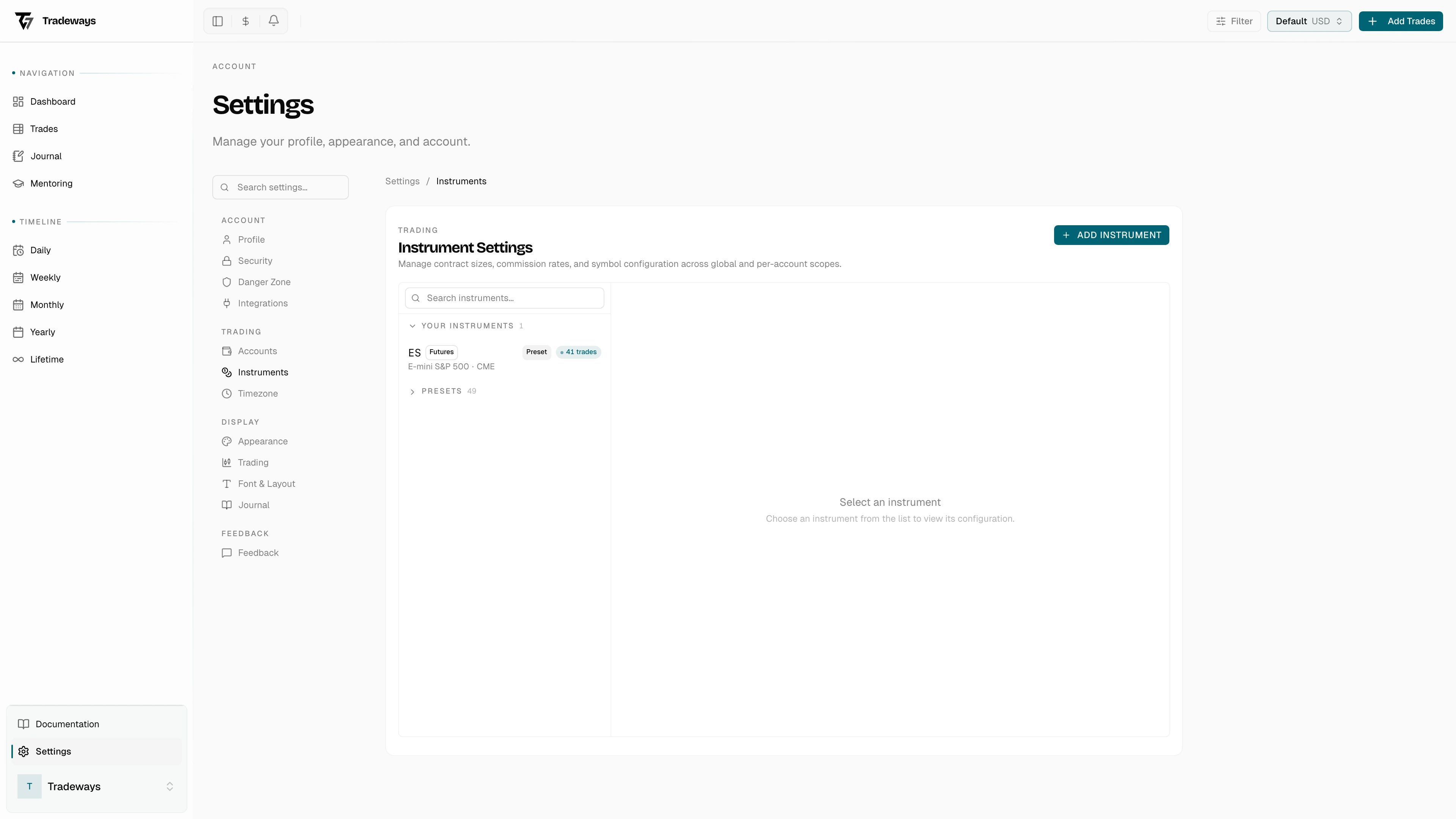
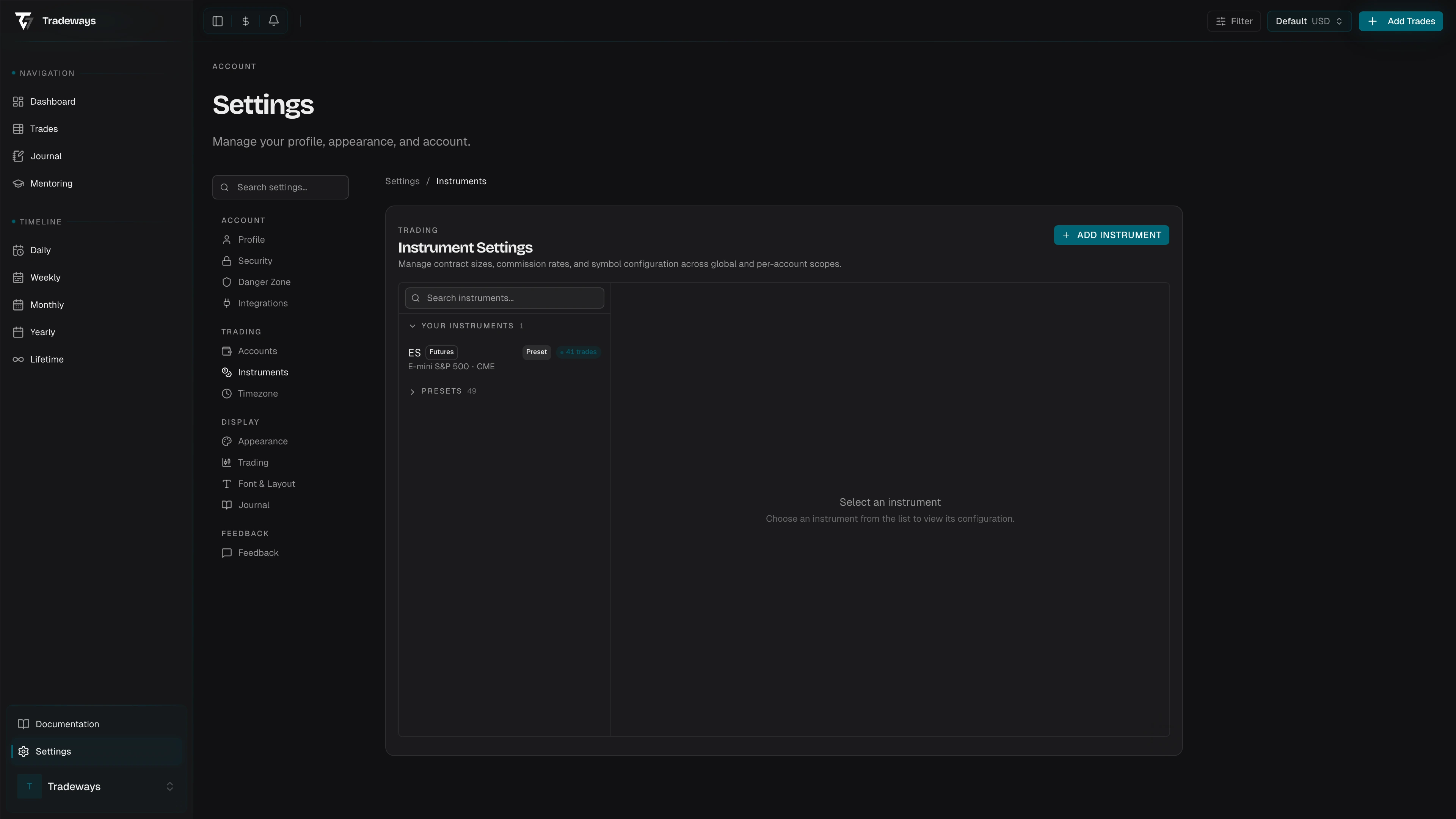
Tradeways resolves instrument configuration automatically using a resolution chain: built-in presets for common futures, auto-detection for forex and crypto pairs, and a fallback for everything else.
Key Fields
| Field | Applies to | Description |
|---|---|---|
| Asset class | All | The instrument category: stocks, futures, crypto, forex, or cfd. |
| P&L unit | All | Either ticks (futures) or currency (all others). Determines which calculation model is used. |
| Tick size | Futures only | The minimum price increment. For ES (E-mini S&P 500), this is 0.25. |
| Point value | Futures only | The dollar value of one full point of price movement. For ES, this is $50 — so one tick (0.25) = $12.50. |
| Contract multiplier | Forex, stocks, crypto, CFDs | A multiplier applied to price differences in P&L calculation. Typically 1 for spot instruments. |
| Lot size | All | The number of units in one standard lot. Forex uses 100,000 (one standard lot). Futures and stocks use 1. |
| P&L currency | All | The currency in which the instrument's P&L is denominated. For EUR/USD, this is USD. For FDAX, this is EUR. |
| Exchange | Futures | The exchange where the instrument trades (e.g. CME, EUREX). Used for exchange-level commission rates. |
P&L Calculation Models
Tick-Based (Futures)
Futures use tick-based P&L. The realized P&L for a matched position is:
pnlInTicks = priceDifference / tickSize
pnlInCurrency = pnlInTicks x tickSize x pointValue
For example, buying 1 ES contract at 5000.00 and selling at 5002.50:
- Price difference: 2.50
- Ticks: 2.50 / 0.25 = 10 ticks
- Currency P&L: 10 x 0.25 x $50 = $125.00
Currency-Based (Forex, Stocks, Crypto, CFDs)
Non-futures instruments use currency-based P&L. The realized P&L is:
pnlInCurrency = priceDifference x quantity x contractMultiplierFor example, buying 10,000 units of EUR/USD at 1.1000 and selling at 1.1050:
- Price difference: 0.0050
- Currency P&L: 0.0050 x 10,000 x 1 = $50.00
Resolution Chain
Tradeways automatically configures common futures (ES, NQ, CL, GC, FDAX, and many more), forex pairs, and crypto pairs. All other instruments use default settings that you can customize.
For instruments that are not automatically recognized, the fallback uses a contract multiplier of 1 and a lot size of 1, treating the instrument like a stock.
Price Unit Names
The display label for the instrument's price unit adapts to its asset class:
| Asset Class | Unit Name | Suffix | Unit Size |
|---|---|---|---|
| Futures | Ticks | t | Tick size from configuration |
| Forex | Pips | pip | 0.0001 (or 0.01 for JPY pairs) |
| CFD | Points | pt | 1.0 |
| Stocks | Cents | ct | 0.01 |
| Crypto | Points | pt | 0.01 |
Commission and Instruments
Commission rates can be set per symbol, per exchange, or as a default. The resolution cascades: a per-symbol rate overrides a per-exchange rate, which overrides the default. The instrument's exchange field (e.g. CME, CME/NYMEX, EUREX) determines which exchange-level rate applies.
Commission is calculated per lot. For example, if you set a rate of $2.50 per lot, Tradeways applies that rate based on the number of lots in each execution.
See Also
- P&L Display Modes — how instrument configuration drives tick vs. currency display
- Multi-Currency & Exchange Rates — conversion when P&L currency differs from account currency
- Trade Adjustments — costs that apply on top of instrument-based P&L