

Tradeways Score
A 0–100 index across four pillars (Edge, Risk, Consistency, Discipline) that points to your weakest pillar first.
Tradeways Score
The Score is your single 0–100 read on how you are trading right now. It is not a leaderboard. It is a diagnostic that tells you which part of your trading is the bottleneck, so the next thing you work on isn't guesswork.
It is calculated over the last 90 days of closed trades, for the accounts in the current account scope and under the global trade filter. It is the equal-weighted average of four pillar scores: Edge, Risk, Consistency, and Discipline. Each pillar's sub-metrics are normalised on smooth curves, so a small change in a raw number produces a small change in the score. There are no hard thresholds that flip you a tier on a single trade.
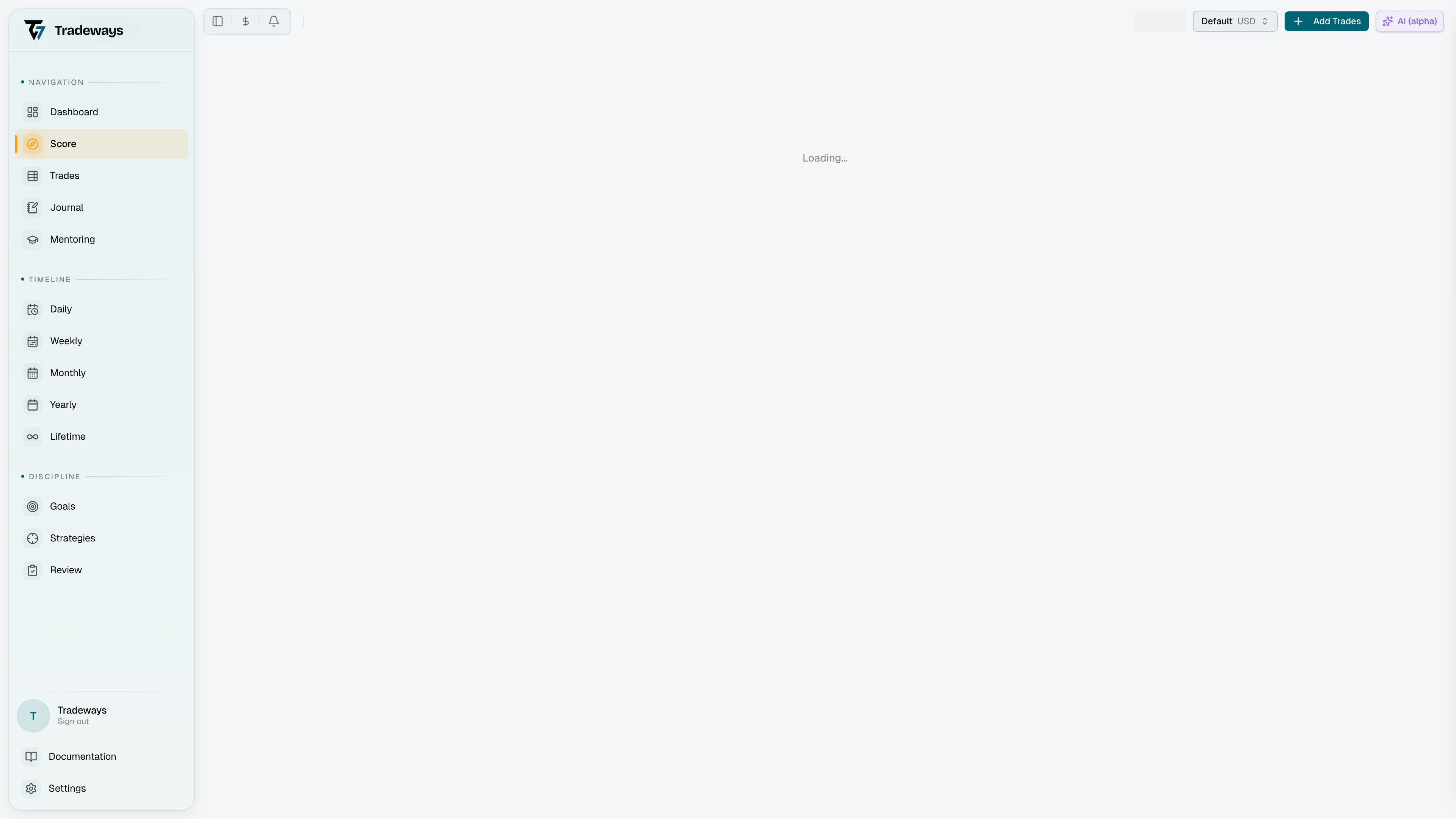
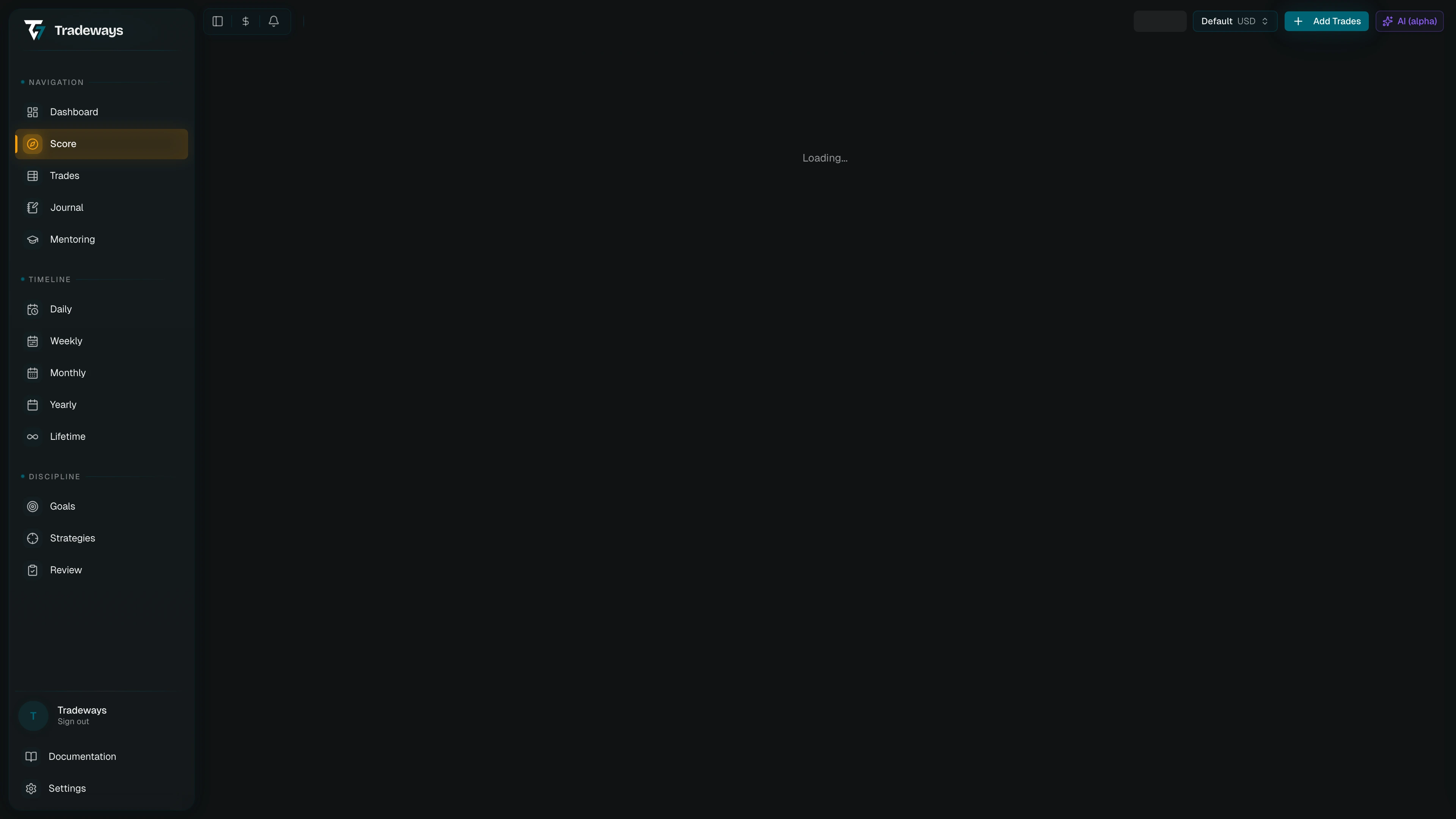
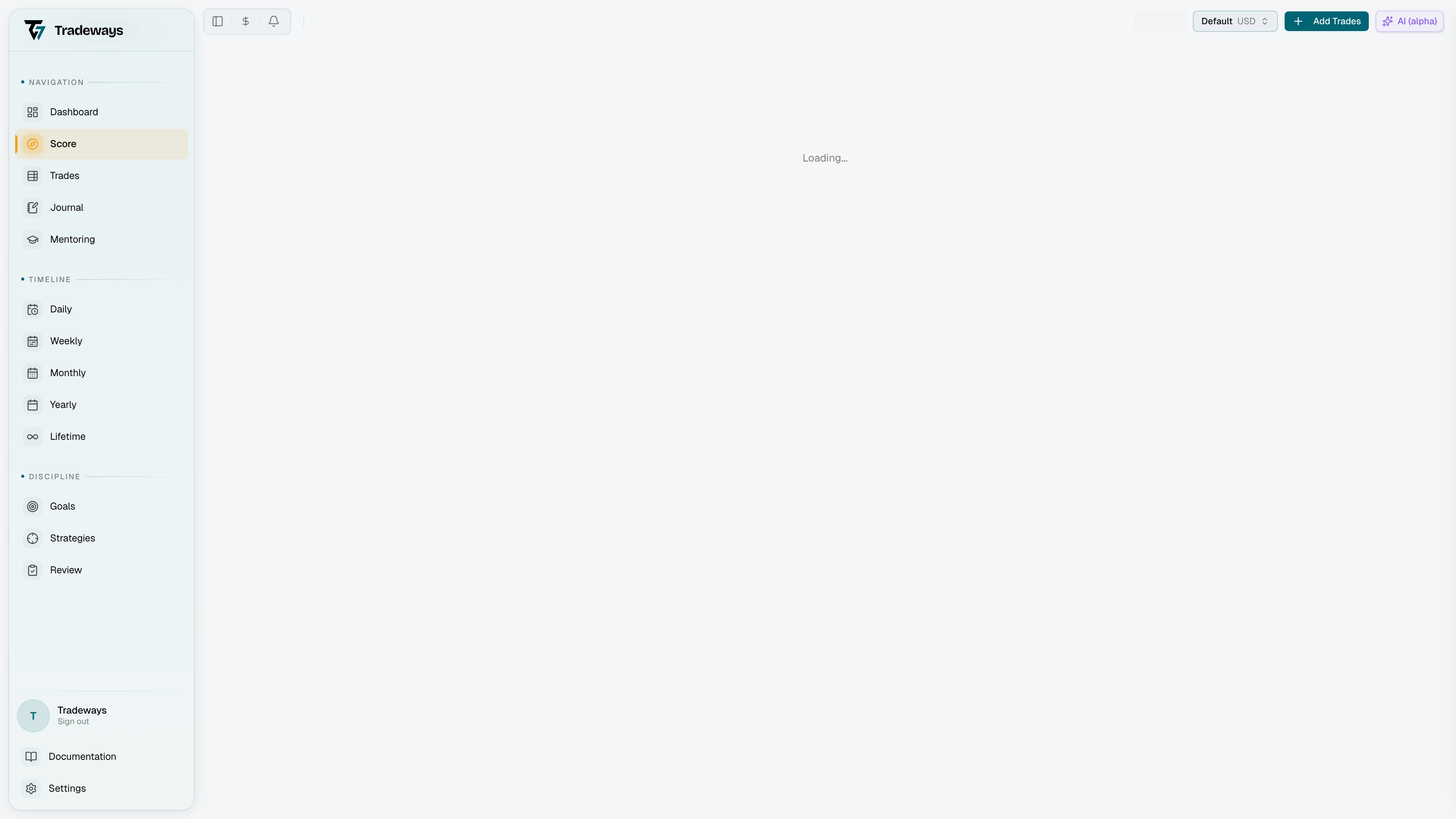
At the top of the page you see the overall number out of 100 and a calibration strip below it: the full 0–100 scale split into the five tier bands, with a marker at your score and the band boundaries labelled. One line under the strip names the next band and how many points away it is. Then come the tier (ELITE, STRONG, STEADY, BUILDING, or FRAGILE), the change versus your score 30 days ago, and a confidence label (Low, Medium, or High confidence) that reflects sample size. The change is shown only when the window 30 days back holds at least five closed trades. To the right is a circular gauge with one segment per pillar; hover a segment to read that pillar in the centre of the gauge, click it to jump to that pillar's card.
Confidence matters: with fewer than 30 closed trades the score is pulled toward 50 so one outlier trade can't fake a great result. Between 30 and 99 trades it is pulled partway. At 100+ trades the score reflects your data with minimal damping.
An "As of" date picker sits under the header. Pick a date and the whole page moves back: the 90-day window then ends on that date. Two buttons jump to 6 months ago and 1 year ago. Clear the date to return to today.
Two callouts can appear when the account isn't ready for a full score. The first asks you to add a starting balance, without which percentage-based risk metrics can't be computed. The second asks you to create a strategy on /strategies, because Plan adherence under Discipline needs trades linked to a written plan. Both are dismissible per account. A separate alert appears when trades or transactions were excluded because an exchange rate was missing; the score is then built from incomplete inputs.
Pillars
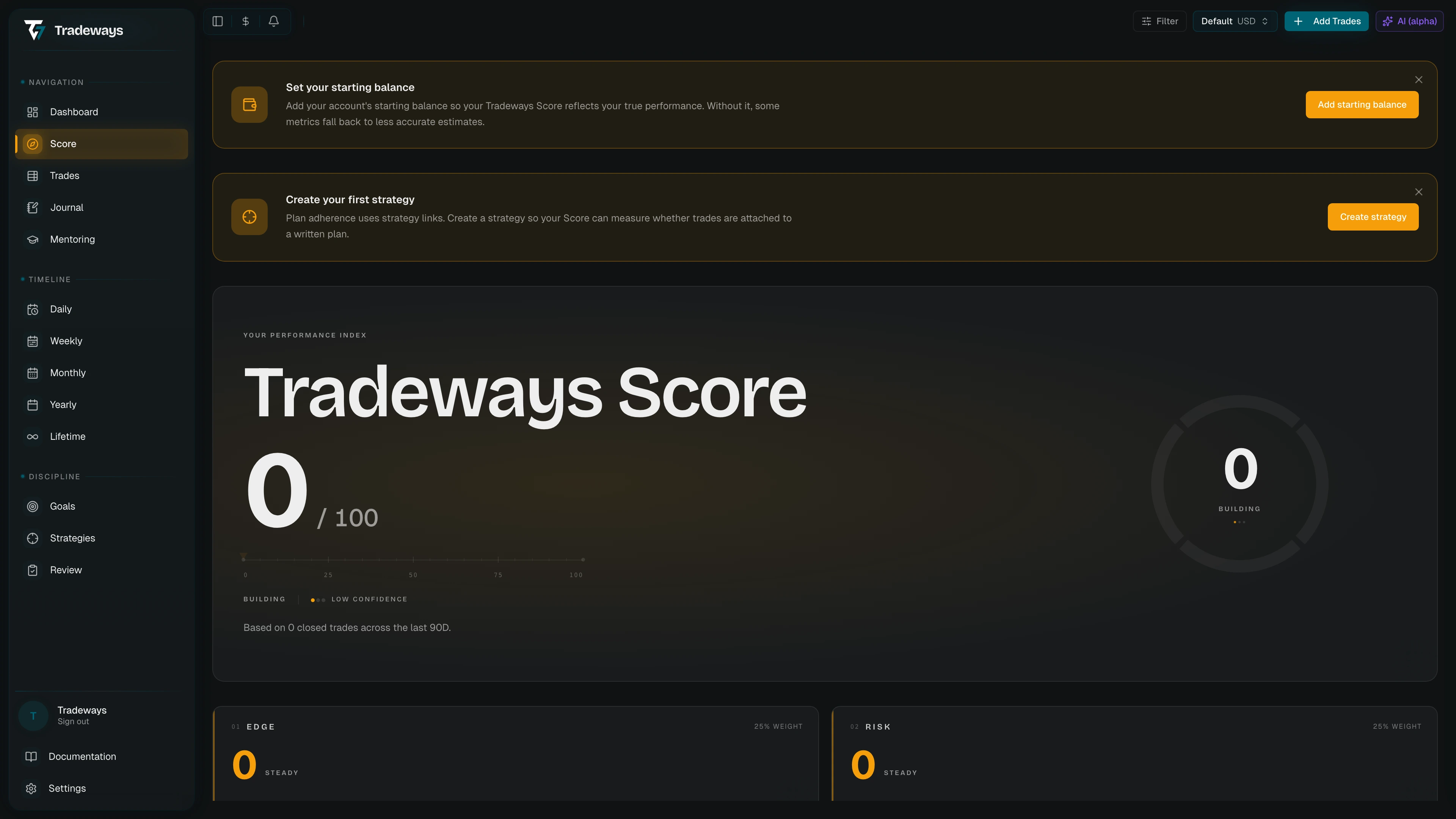
Each pillar has its own card with a 0–100 pillar score, its 25% weight, a short explainer, two concrete improvement tips, and the sub-metrics that feed it. Every sub-metric row shows the raw value, the 0–100 sub-metric score, and an info icon that opens the full definition. Sub-metrics are not equally weighted inside a pillar; the tables below list each weight.
Edge
Edge is the math of profitability: are your winners big enough, given how often you win, to come out ahead after costs? It tolerates a low hit rate when winners are large, and punishes a high hit rate when losers wipe the winners out. The sub-metrics below are the levers, and Expectancy R is the main one to watch.
| Sub-metric | Weight in pillar | What it measures |
|---|---|---|
| Expectancy R | 45% | Average reward-to-risk per trade. 2R is strong, 3R is required for a perfect score. |
| Profit factor | 25% | Gross profit divided by absolute gross loss. Above 1.5 is healthy. |
| Hit rate | 30% | Winners divided by winners plus losers; breakeven trades are excluded. 50% scores strongly, 70% gives a perfect score. |
Risk
Risk is whether you survive a bad run. Small, percentage-based losses defined before you enter: that is the entire job. Two of the three sub-metrics here can blow your account by themselves if you let them, which is why this pillar is usually the one to fix first when the Score is low.
| Sub-metric | Weight in pillar | What it measures |
|---|---|---|
| Max drawdown | 40% | Largest peak-to-trough drop in equity, as a percent of peak. Smaller is better. |
| Recovery factor | 25% | Net profit divided by max drawdown. Above 2 means every unit of drawdown was more than recovered. |
| Risk sizing | 35% | 90th-percentile risk per trade against account equity at entry, from stop distance and quantity when both are available, otherwise from realised losing-trade loss. Repeated 2%+ and 5%+ trades hurt. |
Max drawdown and Risk sizing need a starting balance. Without one, both are held at a neutral score instead of being guessed.
Next to the Risk title sits a badge with the account tier: "Small account" or "Standard rules". Accounts under 10,000 in account currency are scored on relaxed rules — risk sizing is measured against 4% and 8% instead of 2% and 5%, and the drawdown and recovery midpoints move with it. Hover or focus the badge for the active rules, your p90 risk per trade, and where you stand against the thresholds. The badge is hidden when the account balance is unknown.
Consistency
Consistency is whether the equity curve actually climbs or just zig-zags around break-even. Two shapes are valid: a low hit rate carried by big winners, or a high hit rate with steady small wins. The score doesn't care which, as long as the line slopes up.
| Sub-metric | Weight in pillar | What it measures |
|---|---|---|
| Equity-curve R² | 50% | How linear your cumulative P&L is. 1.0 is a perfect straight line up. |
| % Winning days | 50% | Share of trading days that finished green. |
Discipline
Discipline is the part of trading you actually control. For most traders, knowledge isn't the bottleneck; execution is. This pillar is also the easiest to move deliberately: it doesn't require a new edge, just consistent habits after the trade.
| Sub-metric | Weight in pillar | What it measures |
|---|---|---|
| Loss-size variability | 40% | Coefficient of variation of your realised losses. Low values mean capped, predictable losses; high values mean one outlier can undo everything else. |
| Plan adherence | 32% | Share of trades linked to a strategy on /strategies. A proxy for trading a written plan. |
| Journal completeness | 28% | Share of closed trades covered by an execution note, screenshot, review tag, trade note, or a daily/weekly journal entry on the trade's date. |
Score history
Below the pillars, a line chart plots your Score over time with the five tier bands shaded behind it. Each point is the Score of the 90 days ending on that date, so the line is a rolling read rather than a daily snapshot. Hover any point to see the score value, the date, and how many closed trades were in that window. A date is skipped when its window holds fewer than five closed trades, so the chart stays empty until enough history exists.
Score colors
Score colors use the same bands as the five tiers. FRAGILE is red from 0 to 44. BUILDING is amber from 45 to 59. STEADY is green from 60 to 74. STRONG is green from 75 to 89. ELITE is green from 90 to 100. Each overall score, pillar score, and sub-metric uses the color of its own band. Green begins at 60.
Sub-metric comparison
The radar chart plots ten sub-metric scores from the four pillars on one 0–100 ring: the three Edge metrics, the three Risk metrics, both Consistency metrics, loss-size variability, and plan adherence. Journal completeness is not on the ring. It's the fastest way to spot which sub-metrics are pulling weight and which are dragging. The axis labels match the pillar cards above.
Tiers
The tier in the header maps your overall score to a status. The bands are also shaded behind the history chart.
| Tier | Band | What it means |
|---|---|---|
| ELITE | 90–100 | All four pillars strong at the same time. Rare and earned. |
| STRONG | 75–89 | Multiple pillars firing; usually one weakness left to address. |
| STEADY | 60–74 | Working strategy, predictable habits. Most traders live here. |
| BUILDING | 45–59 | Habits forming, pillars uneven. Pick one and lift it. |
| FRAGILE | 0–44 | High risk of blow-up. Fix Risk first, then Discipline, before chasing more Edge. |
What the Score is for
The three cards at the bottom of the page restate this: it's a 0–100 index, not a leaderboard, and it's there to tell you where to look first. Each pillar weighs 25%, sub-metrics are normalised on smooth curves, and thin-data scores are damped toward neutral. The four pillars cover the four things that have to be true at once: you have a strategy, you survive bad runs, the curve climbs, and you execute the plan you wrote. None of them is sufficient on its own.