

Month View
One trading month as a P&L chart and a candle for each day, with week totals and the monthly journal.
Month View
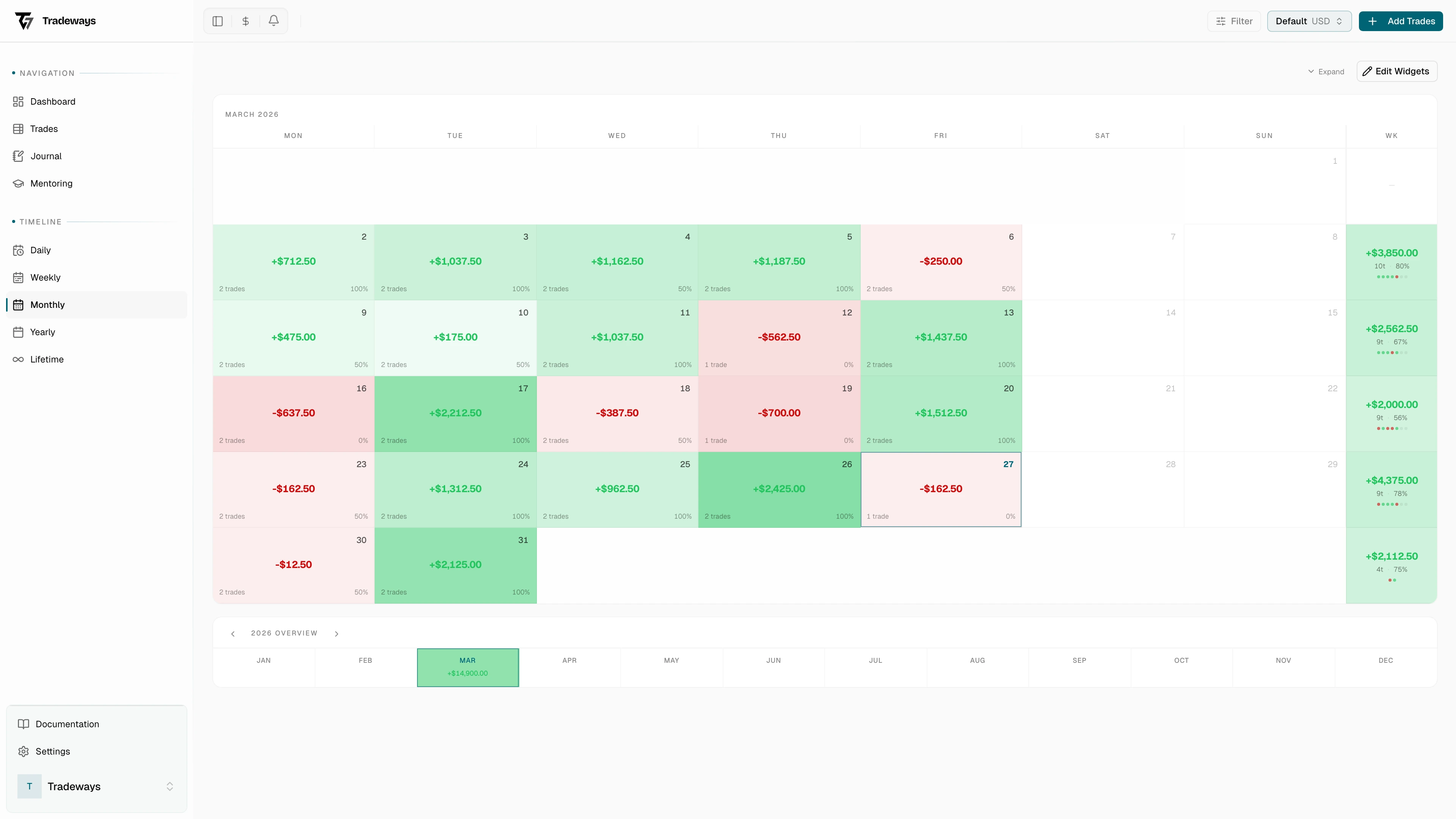
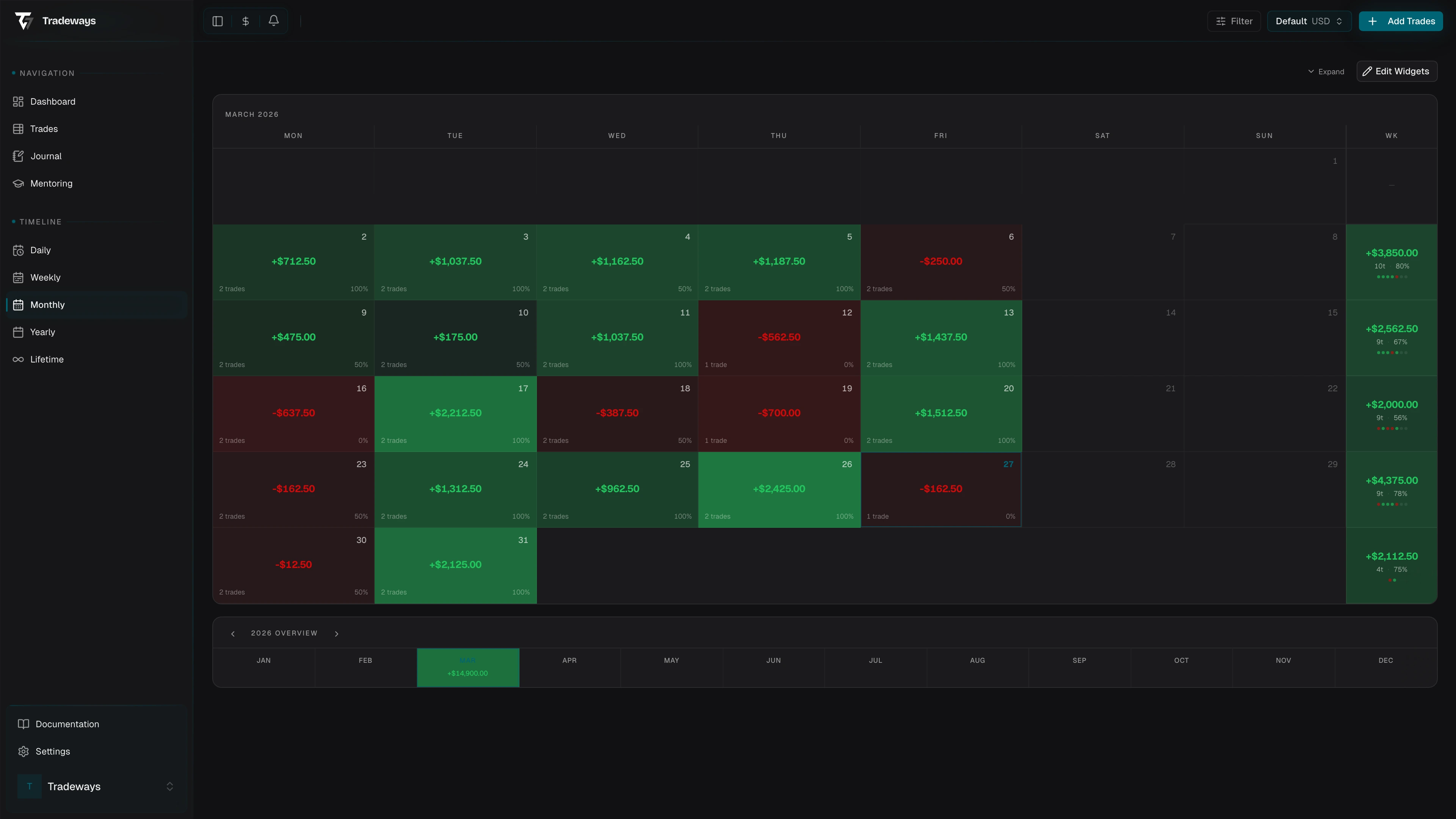
The month view lays the trading month out as a calendar of day candles. Each block is a day, and an extra column carries the week totals. Use it to find the days that drove the month. Without a chosen month, the page opens on the latest month that has trades. Today jumps to the present month.
Path and navigation
The path at the top reads Lifetime / 2026 / ‹ March 2026 ›. Each earlier step is a link that zooms out to that page. The current month opens a picker. The arrows step to the previous and next month, and Today appears when you are not on the present month. The notebook icon on the right opens the monthly journal.
The lead
Under the path, the month's own candle sits beside the month's P&L. A row of figures follows:
- Trades
- Win rate, counting winners against winners plus losers. Breakeven trades do not count.
- Best point and Worst point, the highest and lowest P&L the month reached, open positions included
- Given back from best, how far the month finished below its best point
- Goal status for each recurring goal whose window is a month
A month without trades shows No closed trades in {month} {year}.
P&L chart while trades were on
The chart plots your P&L only while trades were on, day by day. Each day continues from where the previous one closed. Only the stretches with an open trade are drawn, and every pause with nothing open is cut out, shown as a dotted bridge at the level it held.
- The line follows the stored P&L path of each trade, open and closed P&L together, and jumps to the result at each exit.
- A faint band spans the high and low of each price bar.
- The area is green while the day is up from where it began and red while it is down.
- Hover shows the time and the P&L at that moment.
Trades without a stored price path step in at their exit.
The calendar
Days sit in a weekday grid, with a week column at the right edge. Saturday and Sunday columns appear only when a trade closed on one in the displayed month. The leading and trailing days of neighbouring months are dimmed but still show their data and still open.
Each day block shows:
- The day's candle. It opens at zero, its body runs to the day's result, and its wicks reach the best and worst point of the day, open positions included. A tall upper wick on a red day means the day was green and was given back.
- The result, Best, and Worst
- The trade count and win rate
- A green or red tint, stronger for a larger result relative to the largest day of the month. A deep red block is the worst day relative to this month, not relative to your career.
- A journal mark when the day has an entry
Day candles share one vertical scale. The week totals have their own scale. A week candle chains its days the way a chart's next bar opens at the last close, so its wicks are the best and worst point reached across the days in order. A day without trades keeps its block, dimmed, with a dash.
Narrow blocks drop the extremes first, then show a compact figure, then the candle alone.
Select a day to open the daily view. Select a week total to open the weekly view.
The calendar reports results. It does not identify the cause of a result. Use the daily view, trade detail, and journal to review the process behind a day.
Monthly journal
The notebook icon opens the monthly journal in a side panel. The mark on a day opens that day's entry in the same panel. A monthly entry opens with a trade summary of the month. Use it for the review: what the month showed, which rule held, and what to change.
Widgets and filters
Page widgets stay at the top of the page. Configure them in Page widgets.
The page respects the account scope, every global filter except the date, the P&L display mode, the breakeven threshold, and your timezone. The month you pick sets the date. In R multiple mode, a dash means Tradeways cannot calculate an R value from the available realized-loss basis.
See also
- Daily view to drill into a specific day
- Weekly view for one week
- Yearly view to zoom out
- Filter to limit which trades the page considers